
Abdominal Wall Surgery
Specialized care for hernias and incisional hernias of the abdominal wall.
Abdominal wall surgery notably concerns the management of hernias and incisional hernias. The indication and repair technique are tailored to the anatomy of the wall, the symptoms, the medical history and the individual situation of each patient.
UNDERSTANDING
An anatomical structure essential to abdominal support
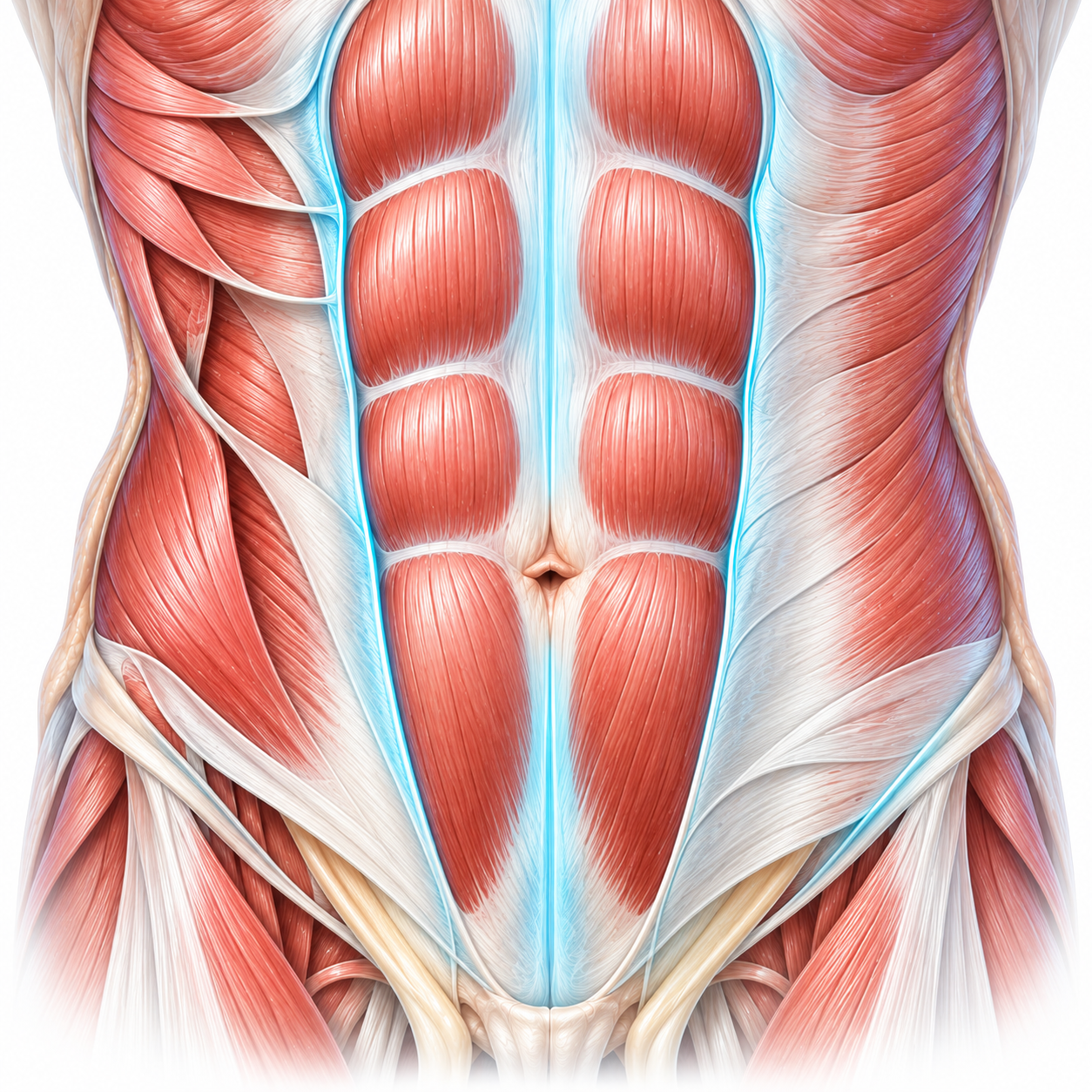
The abdominal wall is made up of several muscular, fascial and aponeurotic layers that contribute to the support and function of the abdomen. At the centre, the rectus abdominis muscles are arranged on either side of the linea alba. Laterally, several muscular and aponeurotic planes complete this architecture. An area of weakness or a failure of this wall can allow a hernia to form. When it occurs at the site of a previous surgical scar, it is referred to as an incisional hernia. Abdominal wall surgery relies on a precise understanding of this anatomy to tailor the treatment approach.
CONDITIONS
Hernias and incisional hernias of the abdominal wall
Hernias of the abdominal wall can appear in different regions and present very variable characteristics. Their management depends notably on their location, their anatomy, the symptoms and the medical context.
Inguinal hernia
An inguinal hernia develops in the groin area. Its evaluation makes it possible to clarify its characteristics and to discuss the indication as well as the repair technique when surgical treatment is chosen.
Learn about inguinal herniaIncisional hernia
An incisional hernia is a weakness of the abdominal wall occurring at the site of a surgical scar. Its management is tailored to the size and location of the parietal defect, the surgical history and the individual context.
Learn about incisional herniaEVALUATION
Care tailored to each individual situation

Not all abdominal wall hernias share the same characteristics, and their management is not based on a single approach. The consultation notably allows the location of the hernia, its impact, any symptoms, medical and surgical history, and the characteristics of the abdominal wall to be assessed.
Imaging tests can be useful in certain situations to clarify the anatomy and prepare the treatment strategy. However, they are not systematically necessary for all patients. The decision to operate and the choice of technique are therefore individualized. To learn more about abdominal wall conditions, the digestive surgery department of the Geneva University Hospitals (HUG) also provides useful information.
SURGICAL TREATMENT
Different repair strategies depending on the situation
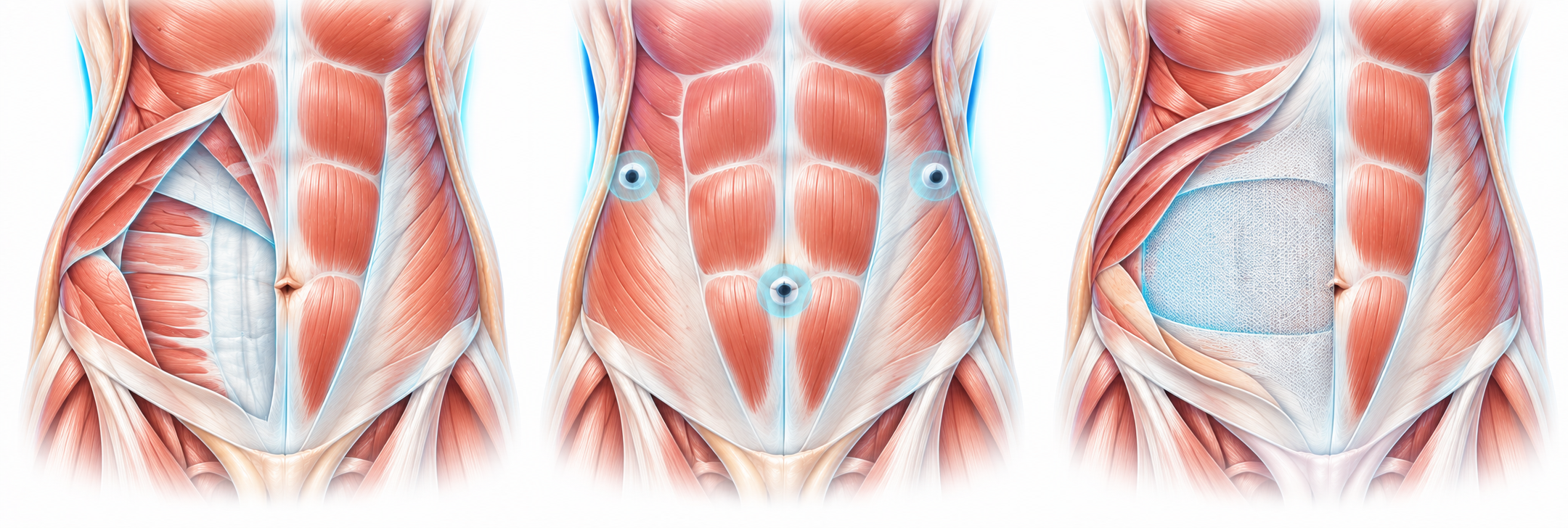
When surgery is indicated, the goal is to appropriately restore the strength of the abdominal wall. The strategy depends on the type of hernia, its anatomy, the medical history and the patient’s characteristics.
Open surgery
Some repairs are performed through a conventional surgical approach. This approach may be appropriate depending on the anatomy of the hernia and the surgical context.
Minimally invasive approach
In certain situations, a laparoscopic or minimally invasive approach may be considered. The choice depends on the indication and the characteristics of the repair to be performed.
Prosthetic reinforcement
Depending on the situation, a reinforcement prosthesis — commonly called a mesh — may be used to strengthen the repair of the wall. Its indication and placement depend on the chosen technique and the individual context.
CHOICE OF TECHNIQUE
How is the technique chosen?
There is no single technique suited to all hernias. The choice depends notably on the type and location of the hernia, its size, tissue quality, any previous abdominal surgery and the patient’s general condition. The surgical consultation allows the different options and their implications to be discussed for the individual situation.
CARE PATHWAY
From consultation to postoperative follow-up
When surgery is chosen, care includes several steps to prepare for the procedure and organize postoperative follow-up.

1. Consultation
The clinical situation and the anatomy of the wall are assessed in order to discuss the indication and the different treatment options.
2. Preparation
An appropriate preoperative evaluation is organized. Additional tests may be requested when useful for care.
3. Surgery
The surgical technique is chosen based on the individual situation and the repair required.
4. Follow-up
Postoperative follow-up supports the gradual recovery and allows recommendations to be adapted, notably regarding the resumption of activities.
AFTER SURGERY
After abdominal wall surgery
Recovery depends on the type of surgery performed, the extent of the repair and the individual situation. Mobilization and the resumption of activities are gradual and adapted to the postoperative context. Instructions regarding wound care, physical activity, work and follow-up are given individually after the procedure. Surgical follow-up allows progress to be monitored and questions arising during recovery to be addressed.
INFORMATION
Appropriate information before surgery
Like any surgical procedure, hernia or incisional hernia repair carries potential risks. Their nature and extent vary depending on the surgery performed, the anatomy of the hernia and the patient’s medical situation. The preoperative consultation allows the proposed surgery, possible alternatives, expected benefits and main risks specific to the individual situation to be explained.
EXPERTISE
An individualized surgical approach

Dr Pierre Fournier manages abdominal wall conditions in Nyon and tailors the surgical strategy to the anatomical and medical characteristics of each situation.
About Dr FournierFAQ
Frequently asked questions about abdominal wall surgery
No. Management depends notably on the type of hernia, its characteristics, symptoms and the individual situation. A consultation allows the indication for surgical treatment to be discussed.
No. A clinical examination may be sufficient in some situations. An ultrasound, CT scan or other test may be requested when useful to clarify the anatomy or prepare care.
No. The use of a prosthetic reinforcement depends on the type of hernia, the planned repair and the individual context.
Some hernias can be managed using a minimally invasive approach. The choice between the different surgical approaches depends on the anatomical and medical situation.
The resumption of activities is gradual and depends on the surgery performed as well as postoperative progress. Recommendations are adapted individually.
Would you like to discuss a hernia or incisional hernia?
A consultation allows your situation to be assessed and the different treatment options in abdominal wall surgery to be discussed when surgery is being considered.
Book an Appointment Contact Us