
NATIONAL ACADEMY OF SURGERY
A commitment to surgery and its transmission
Surgery is built through learning, experience, the evaluation of practices, and the transmission between generations of surgeons.
Dr Pierre Fournier’s membership in the National Academy of Surgery is part of this continuity.
It extends a career devoted to visceral surgery, the evolution of surgical techniques, teaching, and exchanges between professionals.

THE ACADEMY
A historic institution turned toward contemporary surgery
The National Academy of Surgery is part of a long history of transmission and reflection on surgery.
Its contemporary activity concerns in particular the evolution of surgical practices, teaching, the evaluation of new techniques, and the sharing of knowledge between the different surgical disciplines.
Through its sessions, communications and publications, it constitutes a space for exchange between surgeons around the evolutions of their discipline.
Illustration pending: a genuine photograph of the institution to be added at a later stage.
PATH
First learning, then transmitting
Surgical training relies largely on transmission.
At the beginning of his career, a surgeon learns from more experienced physicians and surgeons.
He progressively acquires knowledge, gestures, but also a way of analyzing a situation, preparing an operation, and approaching difficulties.
With experience, this relationship evolves.
Those who were trained progressively become those who accompany and transmit in turn.
This continuity between learning and transmission occupies a particular place in Dr Pierre Fournier’s path.
In a contribution entitled “De l’initiation à la transmission” (“From initiation to transmission”), published by the National Academy of Surgery under the “Coup d’œil du jeune chirurgien” section, Pierre Fournier looks back on different stages of his surgical career and on the surgeons who took part in his training.
Illustration pending: a portrait of Dr Pierre Fournier in an academic context to be added at a later stage.
TRANSMISSION
Knowledge that is not passed on through books alone
Surgery has a particular dimension: a significant part of its learning relies on observation, mentorship and shared experience.
Scientific knowledge is indispensable.
But surgical practice also involves understanding the gestures, their sequence, the technical choices, and how to react to an unforeseen situation.
This transmission between surgeons constitutes surgical mentorship.
It accompanies the different stages of a career.
EXCHANGES
Comparing practices to keep progressing
A surgeon’s experience remains individual.
It nonetheless benefits from being compared with that of other teams.
Presenting a technique, discussing an indication, analyzing a difficulty, or comparing different strategies helps put practices into perspective.
Academic exchanges thus contribute to a broader approach: continuing to learn throughout one’s career.
Illustration pending: a photograph of an exchange between surgeons to be added at a later stage.
INNOVATION
Evaluating new techniques before integrating them into practice
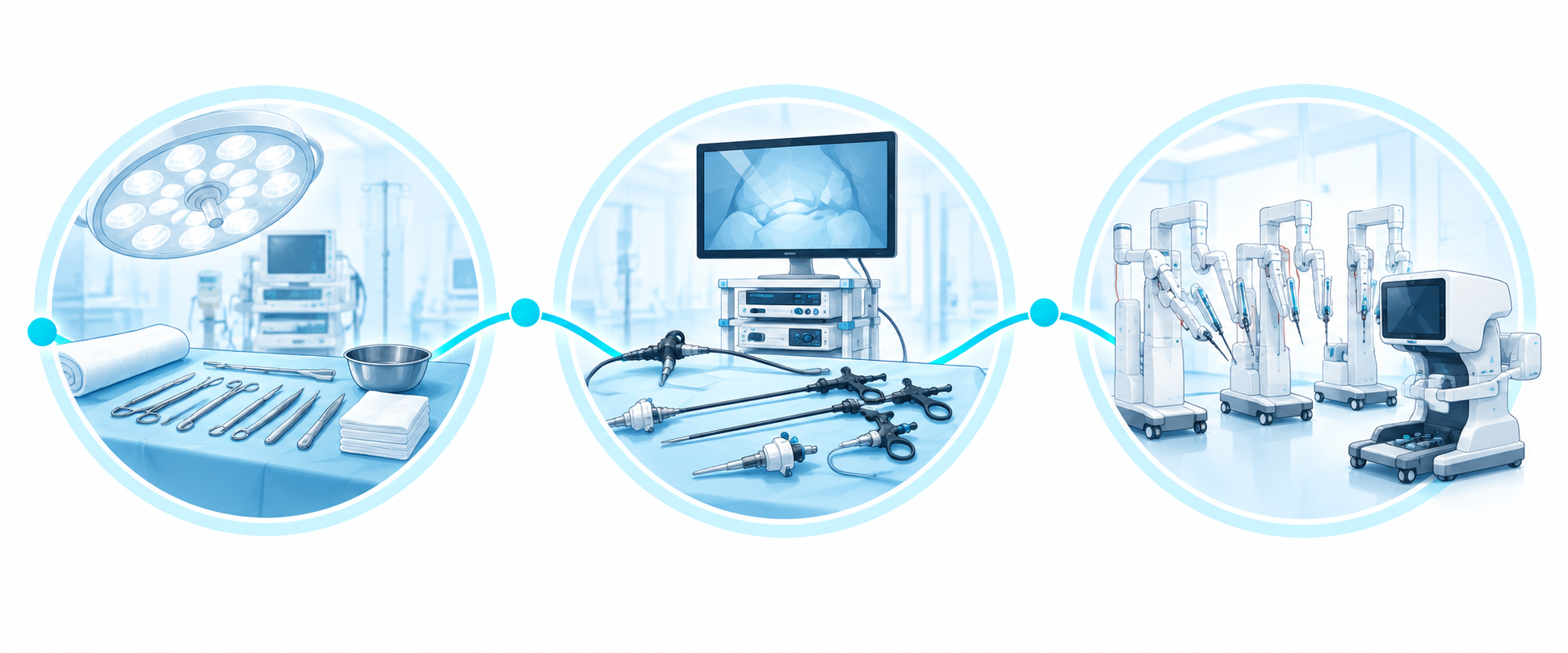
Surgery evolves alongside medical knowledge, instruments, imaging and technologies.
The appearance of a new technique does not, however, mean that it should automatically replace the previous ones.
It must be understood, taught, evaluated, and used when the situation justifies it.
This approach concerns in particular the evolution of minimally invasive surgery and robot-assisted surgery.
Surgical innovation thus remains inseparable from evaluation and critical thinking.
CONFRONTING IDEAS
Presenting, discussing, questioning
A scientific community does not progress through consensus alone.
It also progresses through discussion.
Presenting an experience or an innovation allows other surgeons to question it, compare it with their own practices, and discuss its limits.
This professional confrontation contributes to the evaluation of practices and the dissemination of knowledge.
Illustration pending: a photograph of an academic session to be added at a later stage.
PUBLICATIONS
Preserving and sharing surgical knowledge
Scientific transmission also takes place through writing.
Communications presented within the Academy can be preserved and made accessible through its publications.
The e-Mémoires of the National Academy of Surgery thus allow access to work devoted to the various surgical disciplines.
This documentation contributes to preserving and disseminating surgical experience.
Transmitting without ceasing to evolve
The history of surgery rests on a continuous transmission of knowledge.
But transmitting does not mean reproducing identically.
Each generation has new knowledge, new instruments, and new technical possibilities.
The challenge is therefore to preserve useful experience while knowing how to question practices when knowledge evolves.
This interplay between experience and innovation is one of the characteristics of contemporary surgery.

A practice that remains open to evaluation and exchange
For a patient, belonging to an academic institution is not in itself a guarantee of outcome.
It does, however, reflect a professional activity that is not limited to daily practice.
It is also part of:
- exchanges between surgeons
- continuing education
- discussion of practices
- evaluation of innovations
- transmission of knowledge
These dimensions complement clinical experience without ever replacing the individual analysis of the patient’s situation.
Passing it on in turn
Dr Pierre Fournier’s academic commitment is part of a broader activity of teaching and training.
This transmission concerns in particular visceral surgery, minimally invasive surgery, and supporting surgeons in learning new operative technologies.
Surgery built on experience, exchange and transmission
Surgical practice evolves throughout a career.
Learning, clinical experience, engagement with scientific evidence, and transmission all contribute together to this evolution.