
Esophagogastric Surgery
Specialized care for conditions affecting the junction between the esophagus and the stomach.
Esophagogastric surgery notably concerns certain conditions related to gastroesophageal reflux disease and hiatal hernia. The decision to operate is based on an individualized evaluation of symptoms, anatomy and test results.
Understanding the junction between the esophagus and the stomach
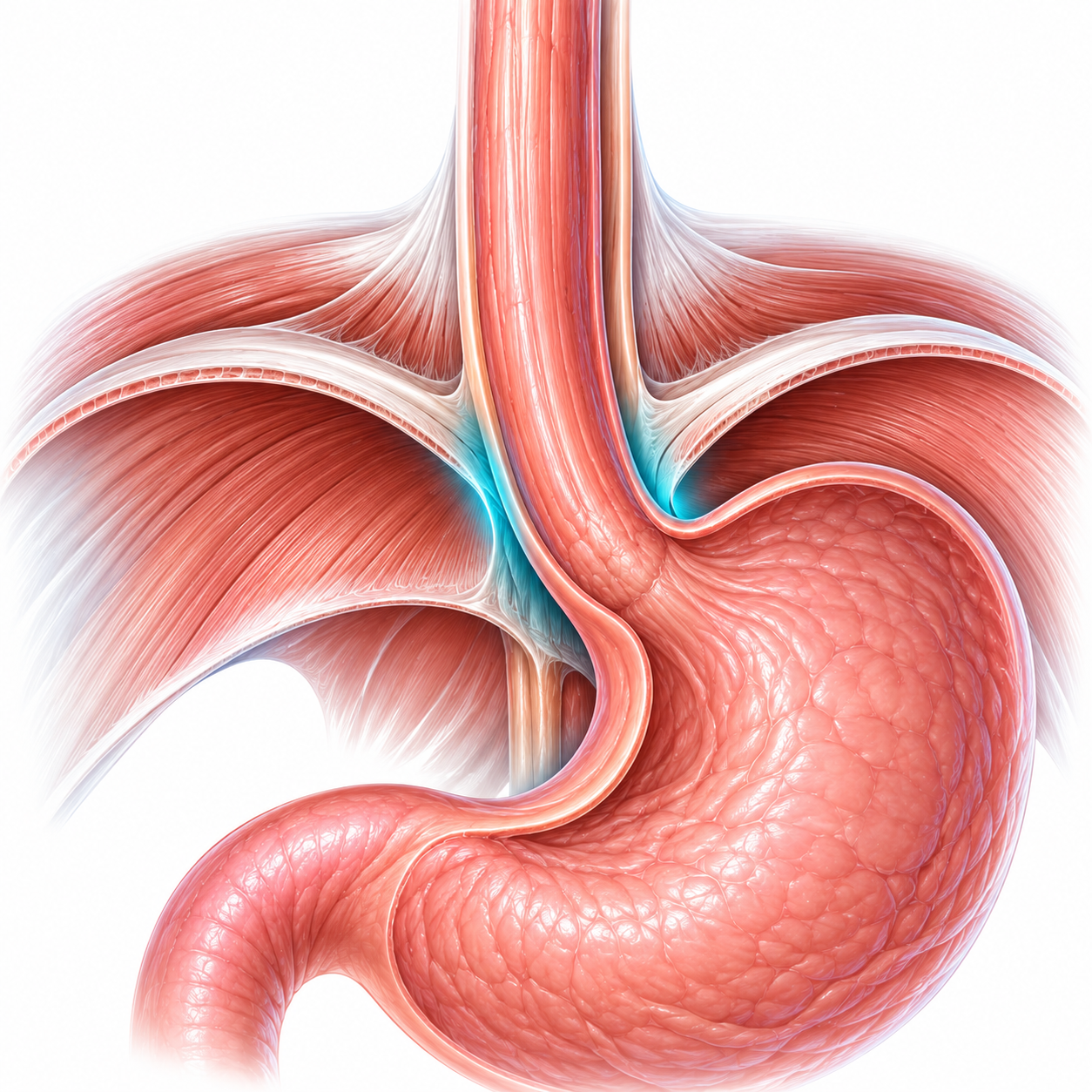
The esophagus crosses the diaphragm through an opening called the esophageal hiatus before joining the stomach.
The gastroesophageal junction and the diaphragm work together in the mechanism that normally limits the backflow of gastric contents into the esophagus.
A change in this anatomy or in the function of this region can contribute to digestive symptoms and, in some situations, lead to a specialized evaluation.
The goal is not to treat an image or a test result in isolation, but to understand each patient’s anatomical and functional situation.
Conditions We Treat
Gastroesophageal Reflux Disease
Gastroesophageal reflux disease is the repeated backflow of gastric contents into the esophagus. It can cause heartburn, regurgitation or other digestive or extra-digestive symptoms. Most patients do not require surgery. Surgical treatment may be discussed in certain situations after an appropriate evaluation.
Hiatal Hernia
A hiatal hernia occurs when part of the stomach passes through the esophageal hiatus of the diaphragm. Its presence does not automatically mean that surgery is necessary. The approach depends notably on the type of hernia, its size, symptoms and the clinical context.
Before Considering Surgery

Digestive symptoms alone are not sufficient to determine whether surgery is indicated.
The evaluation begins with the clinical history, the nature of the symptoms, their frequency, their impact and any treatments already tried.
Depending on the situation, various tests can then help clarify the diagnosis and understand how the esophagogastric junction is functioning.
Clinical Evaluation
Analysis of the symptoms, their evolution, the treatments already used and their effectiveness.
Anatomical Evaluation
Upper digestive endoscopy and, depending on the situation, other tests allow the esophagus, the gastroesophageal junction and the stomach to be examined.
Functional Evaluation
In certain situations, tests such as pH monitoring or esophageal manometry can provide additional information before a treatment decision.
Not all patients require the same tests. The work-up is tailored to each individual clinical situation.
For patients and families seeking further general information on gastroesophageal reflux disease, the Gastroenterology and Hepatology Department of the Geneva University Hospitals (HUG) also publishes patient-oriented resources on digestive conditions.
When Can Surgery Be Considered?
Surgery is not proposed based on the presence of symptoms, reflux or a hiatal hernia alone.
The decision depends on the correlation between symptoms, anatomical findings, the results of functional tests when necessary, response to treatment and the patient’s expectations.
In certain selected situations, surgical correction may be discussed in order to restore a more physiological anatomy of the esophagogastric junction and/or reinforce the anti-reflux function.
Understanding the symptoms
Confirming the anatomical and functional situation
Choosing a strategy tailored to the patient
Surgery Tailored to Anatomy and Clinical Situation
When a surgical indication is confirmed, the procedure is adapted to the condition identified and to the patient’s characteristics.
Depending on the situation, it may notably involve repositioning the gastroesophageal junction within the abdomen, repairing the diaphragmatic hiatus and, when indicated, performing an anti-reflux procedure.
The goal is to correct the anatomical problem while preserving digestive function as much as possible.
The exact technique is chosen individually after analysis of the preoperative work-up.
Your Journey Around the Procedure

01 — Consultation
Understanding the symptoms, the diagnosis, tests already performed and the patient’s expectations.
02 — Work-up and Preparation
Completing the anatomical and functional evaluation if necessary and preparing for surgery when indicated.
03 — Surgery
The surgical strategy is tailored to the patient’s anatomy and clinical situation.
04 — Postoperative Follow-up
Follow-up care supports the gradual resumption of eating, symptom evolution and postoperative recovery.
An Individualized Surgical Decision

Esophagogastric surgery requires correlating the patient’s symptoms with their anatomy and the results of available tests.
Dr Pierre Fournier favors an individualized approach: confirming the indication, explaining the different treatment options and choosing a strategy tailored to each situation.
When surgery is not indicated, the specialized evaluation should also help direct the patient toward appropriate care.
Questions fréquentes
No. Most patients with reflux do not require surgery. Surgery is discussed in certain selected situations after a clinical evaluation and, when necessary, additional tests.
No. The decision depends notably on the type of hernia, its size, symptoms, any potential consequences and the individual context.
The work-up depends on each situation. It may include an upper digestive endoscopy and, depending on the case, functional tests such as pH monitoring or esophageal manometry.
No procedure can guarantee an identical result for every patient. The goal is to select the right indications and tailor the technique to the individual situation.
The resumption of eating is gradual and depends notably on the type of procedure and postoperative progress. Tailored guidance is given to the patient as part of their follow-up care.
Would you like to discuss your situation?
A specialized consultation allows us to analyze your symptoms, any tests already performed and the different treatment options suited to your situation.