
MINIMALLY INVASIVE SURGERY
Robotic surgery
Technology serving the surgical gesture
Robot-assisted surgery combines the principles of minimally invasive surgery with three-dimensional vision and articulated instruments controlled by the surgeon.
At GHOL – Nyon Hospital, I use the Medtronic Hugo™ RAS platform for certain visceral and digestive surgery procedures.
The robot does not operate alone.
The surgeon remains in control throughout the entire procedure.
The indication for a robotic approach depends on the procedure, the anatomy and each patient’s situation.
What is robotic surgery?
A surgery performed by the surgeon, assisted by a robotic platform
The term “robotic surgery” can give the impression that a machine performs the procedure.
This is not the case.
The surgeon controls the instruments during the operation from a console located in the operating room.
His movements are transmitted to the instruments positioned inside the abdomen through the robotic arms.
The surgeon also controls the camera and remains responsible for every step of the procedure.
It would therefore be more accurate to speak of robot-assisted surgery.
The robot is a technological interface between the surgeon’s gestures and the surgical instruments.
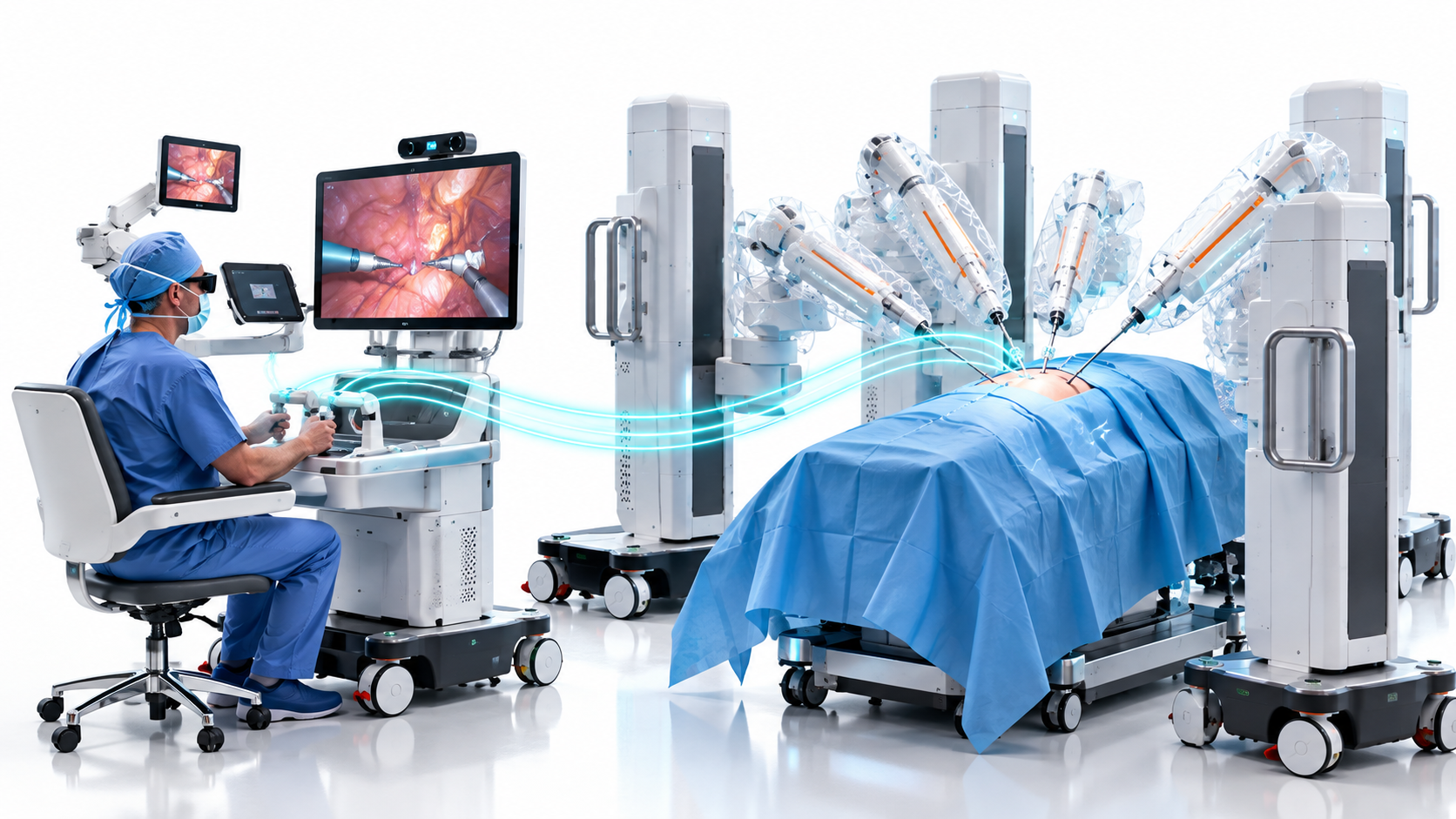
Hugo™ RAS: a modular architecture
Independent arms around the patient
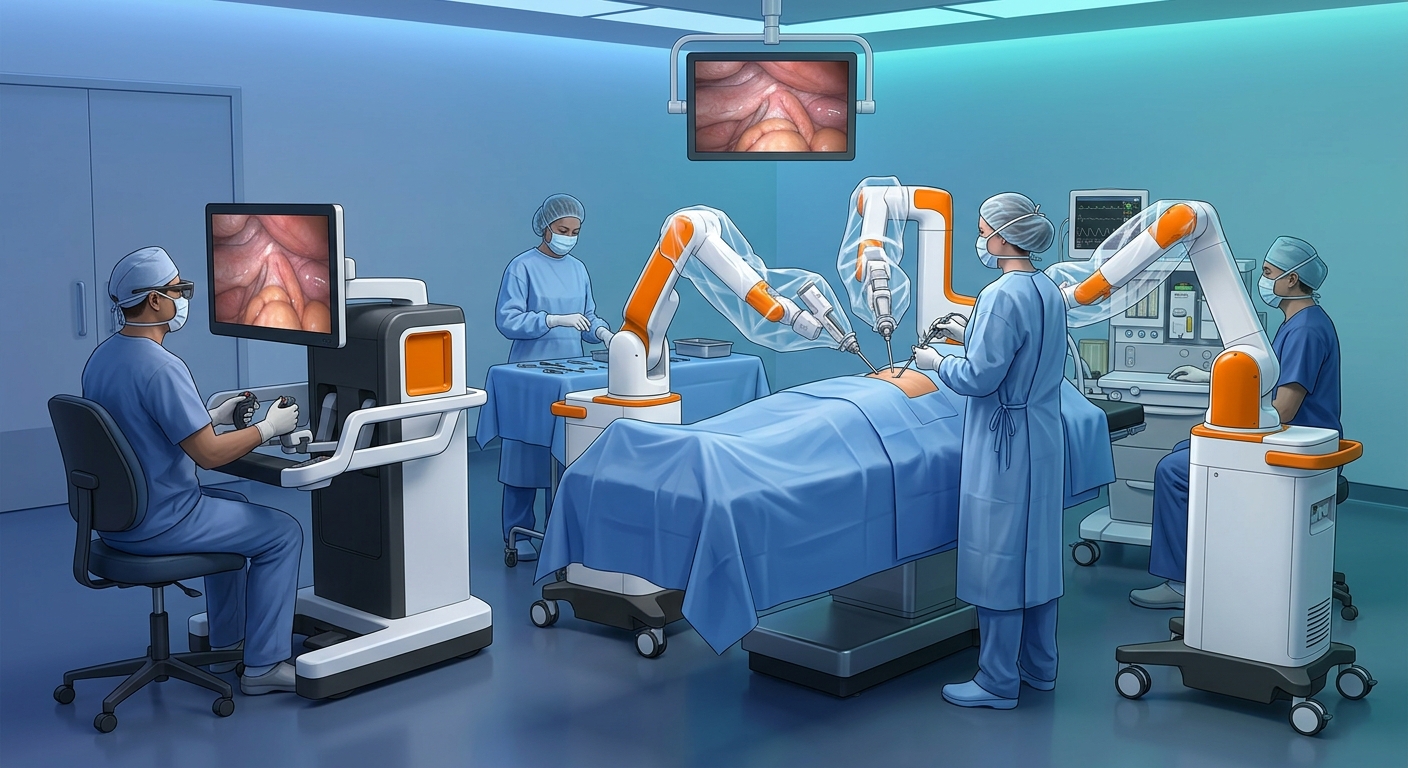
One of the immediately visible features of Hugo™ is its modular architecture.
Unlike an architecture in which several arms originate from a single central unit, Hugo™’s arms are mounted on independent carts.
They can be positioned around the patient depending notably on:
- the procedure
- the anatomy
- the patient’s position
- the chosen access routes
- and the surgical strategy
This architecture allows different system configurations.
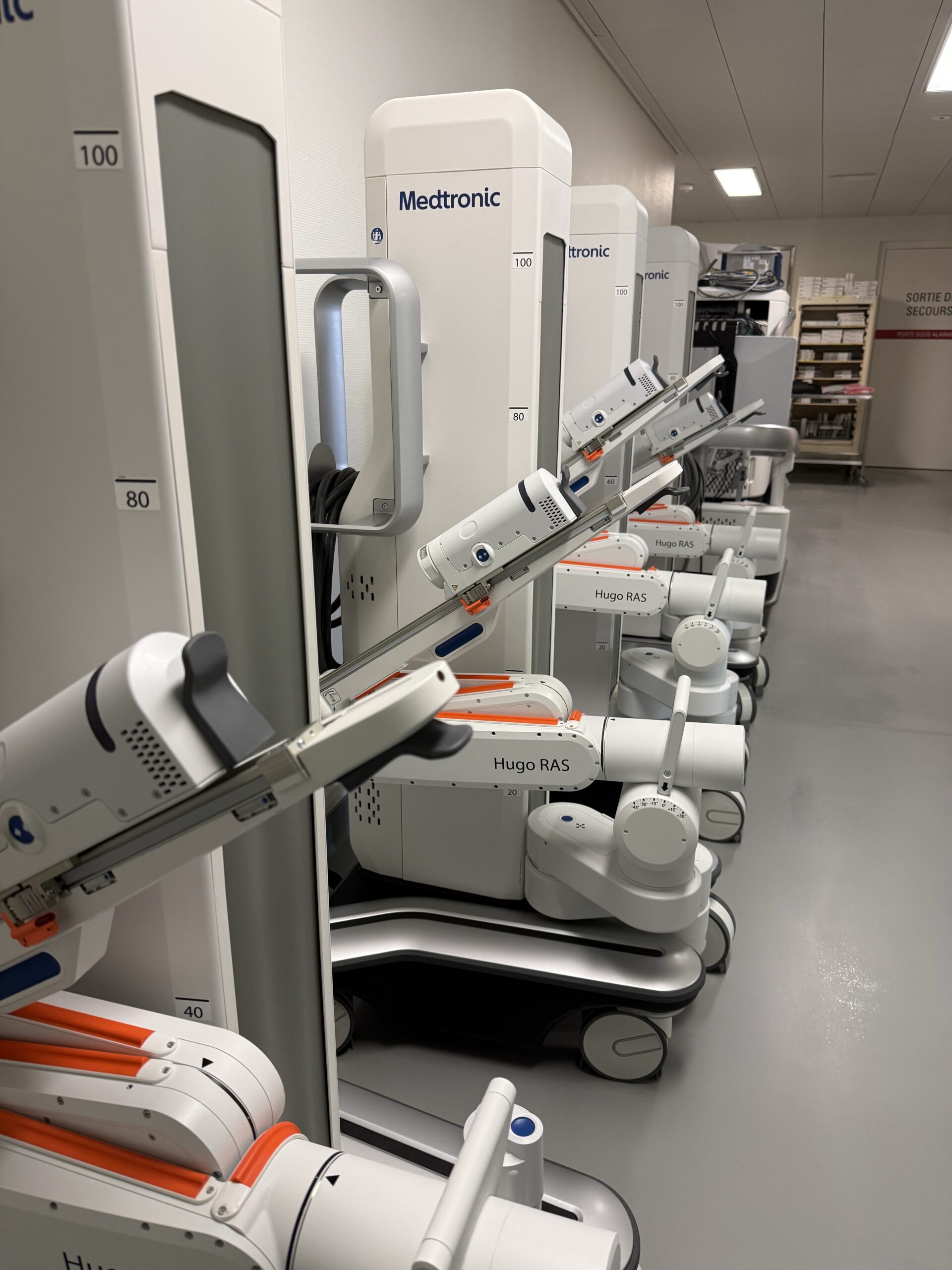
The open console
The surgeon stays connected to the operating room
Hugo™ uses an open console.
The surgeon sits in front of a screen and wears glasses enabling three-dimensional visualization.
His hands use controllers to command the instruments.
Unlike a console enclosed around the face, this architecture allows the surgeon to maintain direct visual contact with the operating environment.
This feature is also valuable for:
- communication with the team
- observation
- teaching
- and proctoring
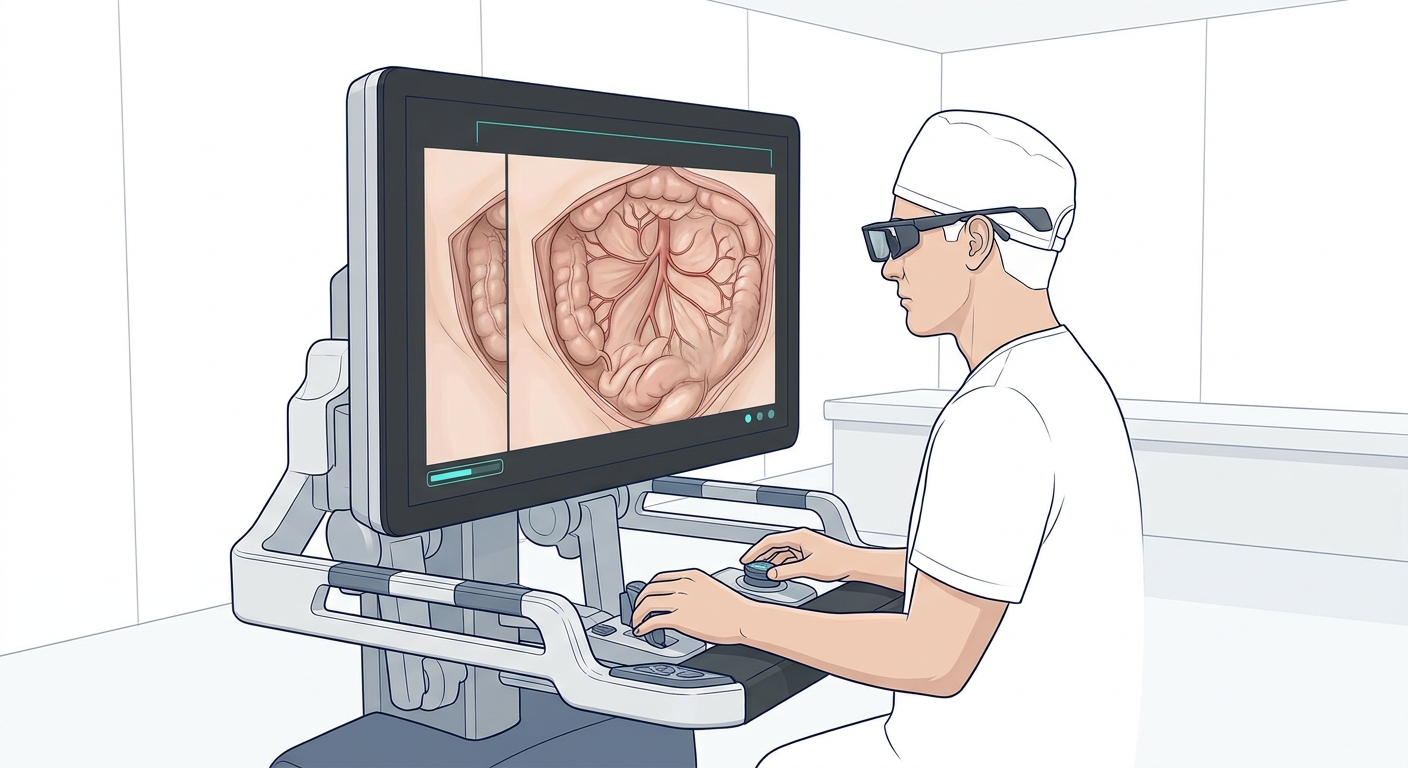
Seeing in three dimensions
A perception of depth during the procedure
In minimally invasive surgery, the surgeon operates while observing the surgical field on a screen.
With Hugo™, the surgeon has HD 3D visualization.
Perceiving depth and the relationships between anatomical structures contributes to analyzing the surgical field and performing technical gestures.
This visualization can be particularly valuable when the procedure requires precise dissection in a complex anatomical space.
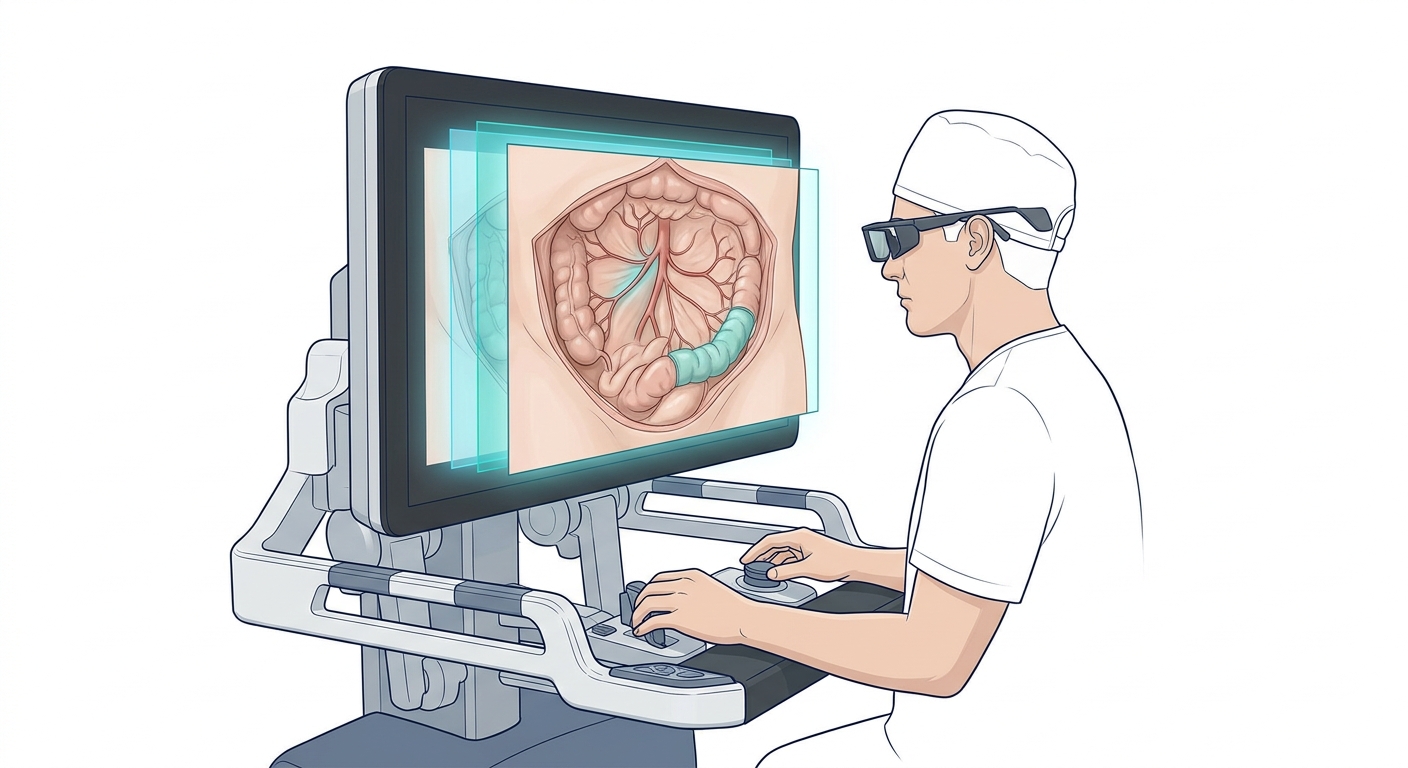
Articulated instruments
Working from different angles
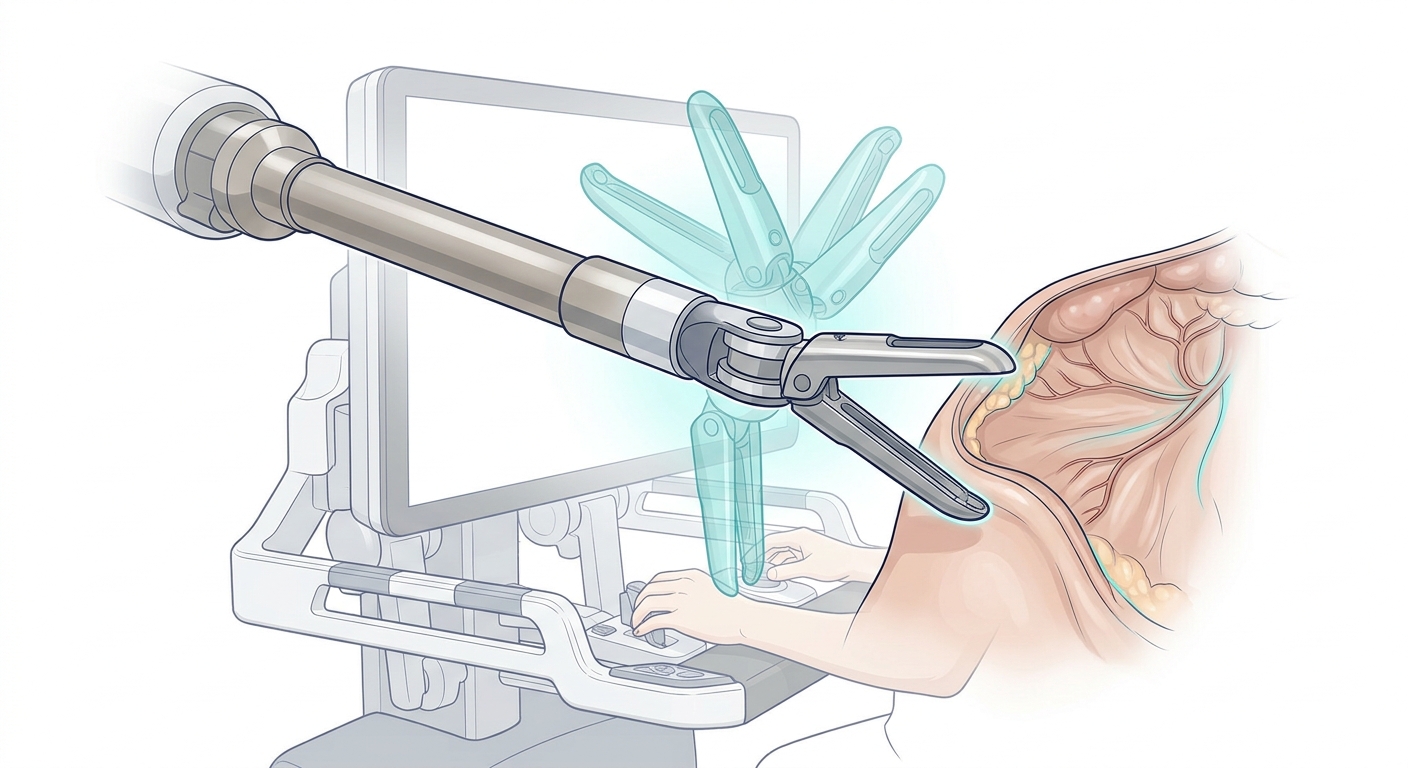
The instruments used with the robotic platform have several degrees of freedom.
Their articulated tip allows the surgeon to perform movements inside the body that differ from those obtained with certain rigid laparoscopic instruments.
This mobility can be useful for certain gestures such as:
- dissection
- grasping
- suturing
- and working in restricted anatomical spaces
The quality of the gesture nevertheless always depends on the surgeon who commands the instrument.
Why use robotic assistance?
An additional tool in minimally invasive surgery
Conventional laparoscopy already allows many abdominal procedures to be performed through small access routes.
Robotics therefore does not make laparoscopy obsolete.
It instead adds another tool to minimally invasive surgery.
Certain features can be valuable when a procedure notably requires:
- meticulous dissection
- good depth perception
- intracorporeal suturing
- significant instrument mobility
- or work in a restricted anatomical space
The goal is not to use the robot at all costs.
The goal is to choose the approach appropriate to the procedure.
A technical advantage in deep spaces
The pelvis is one example
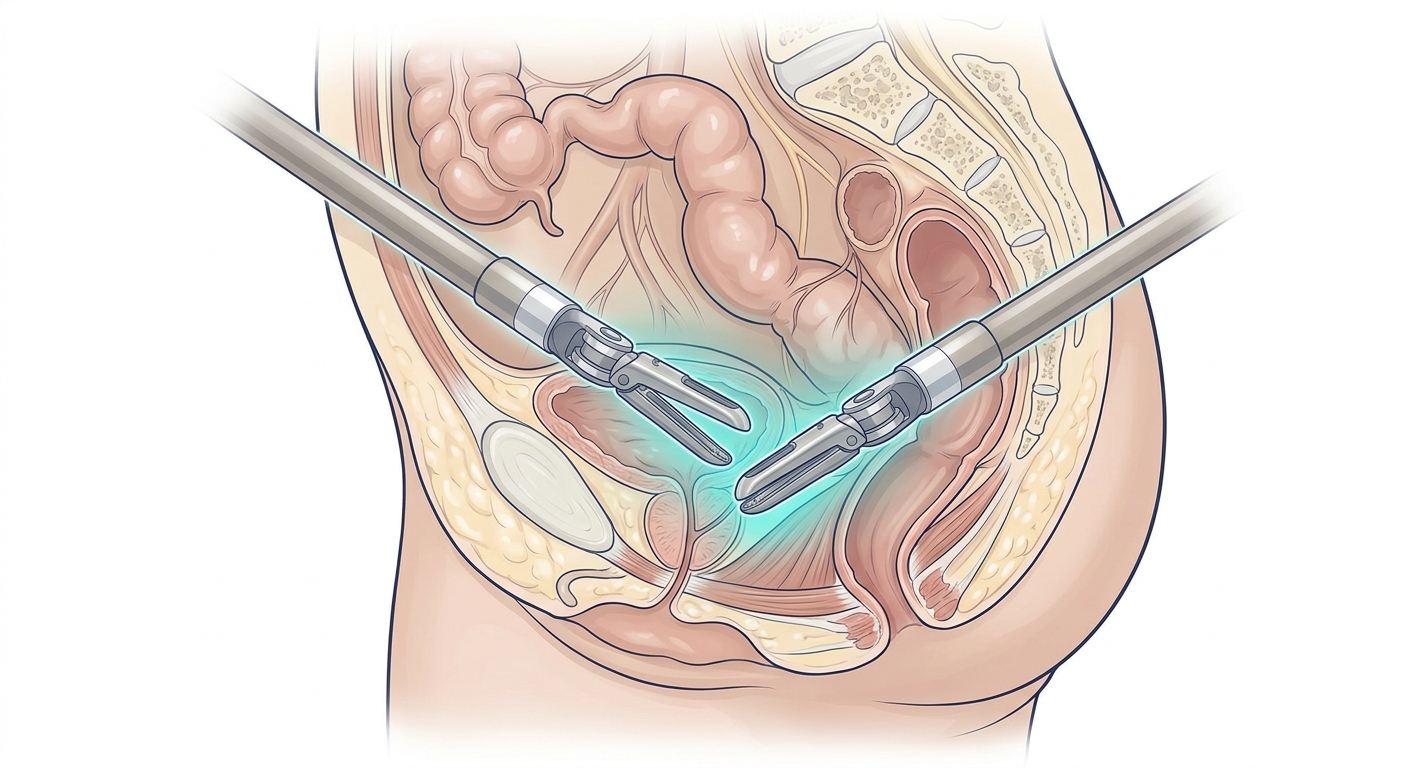
Certain colorectal procedures require working deep within the pelvis.
The available space there is limited and several important anatomical structures lie close to one another.
The three-dimensional vision and instrument mobility offered by robotics then constitute valuable technical features for the surgeon.
Robotics and laparoscopy
Two minimally invasive surgery techniques
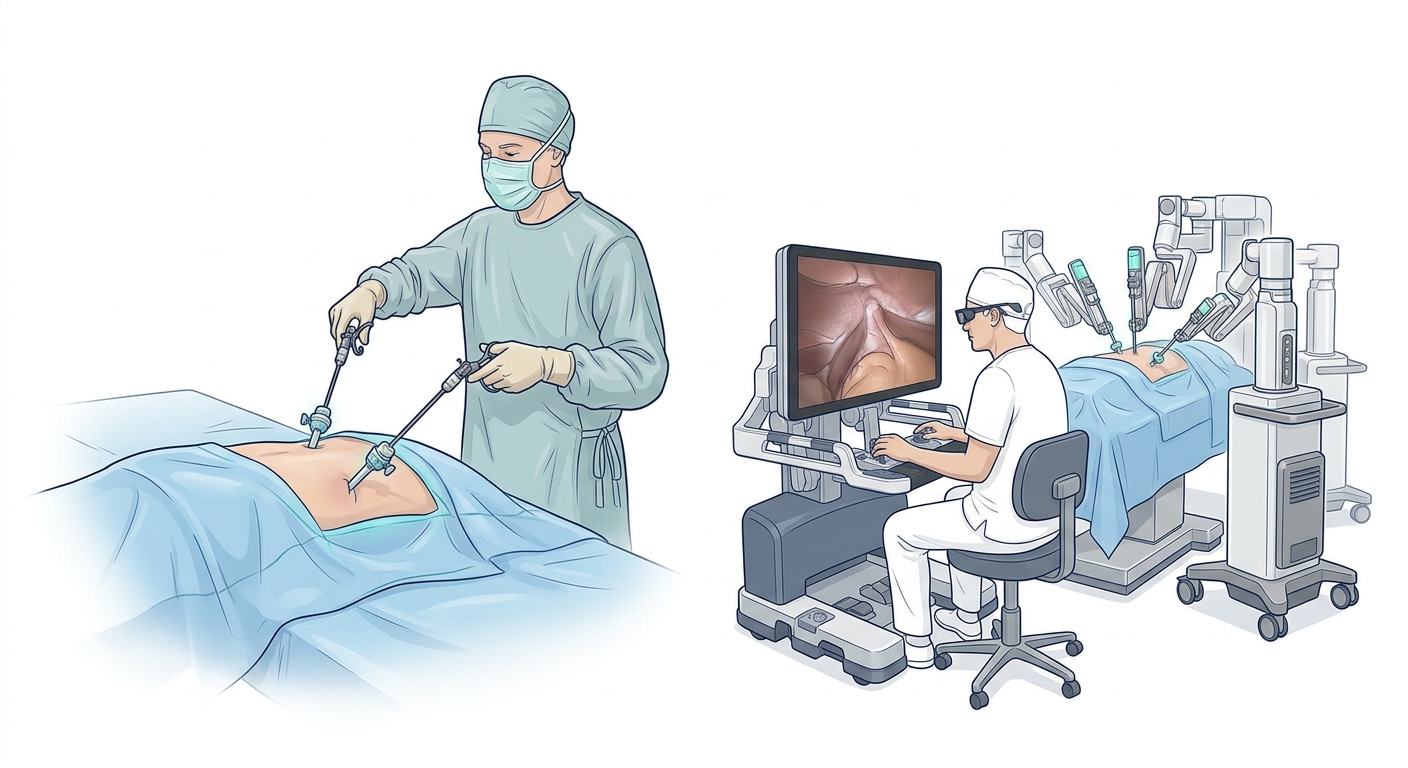
Laparoscopy and robot-assisted surgery share a common principle:
performing the procedure through small access routes rather than a large abdominal opening whenever appropriate.
In laparoscopy, the surgeon directly manipulates the instruments.
In robot-assisted surgery, the surgeon commands the instruments from a console.
These two approaches should not be presented as two levels of a hierarchy.
The choice depends on numerous factors, including:
- the nature of the procedure
- the anatomy
- the patient’s history
- the surgical strategy
- and the team’s experience
In which fields?
Several applications in visceral and digestive surgery
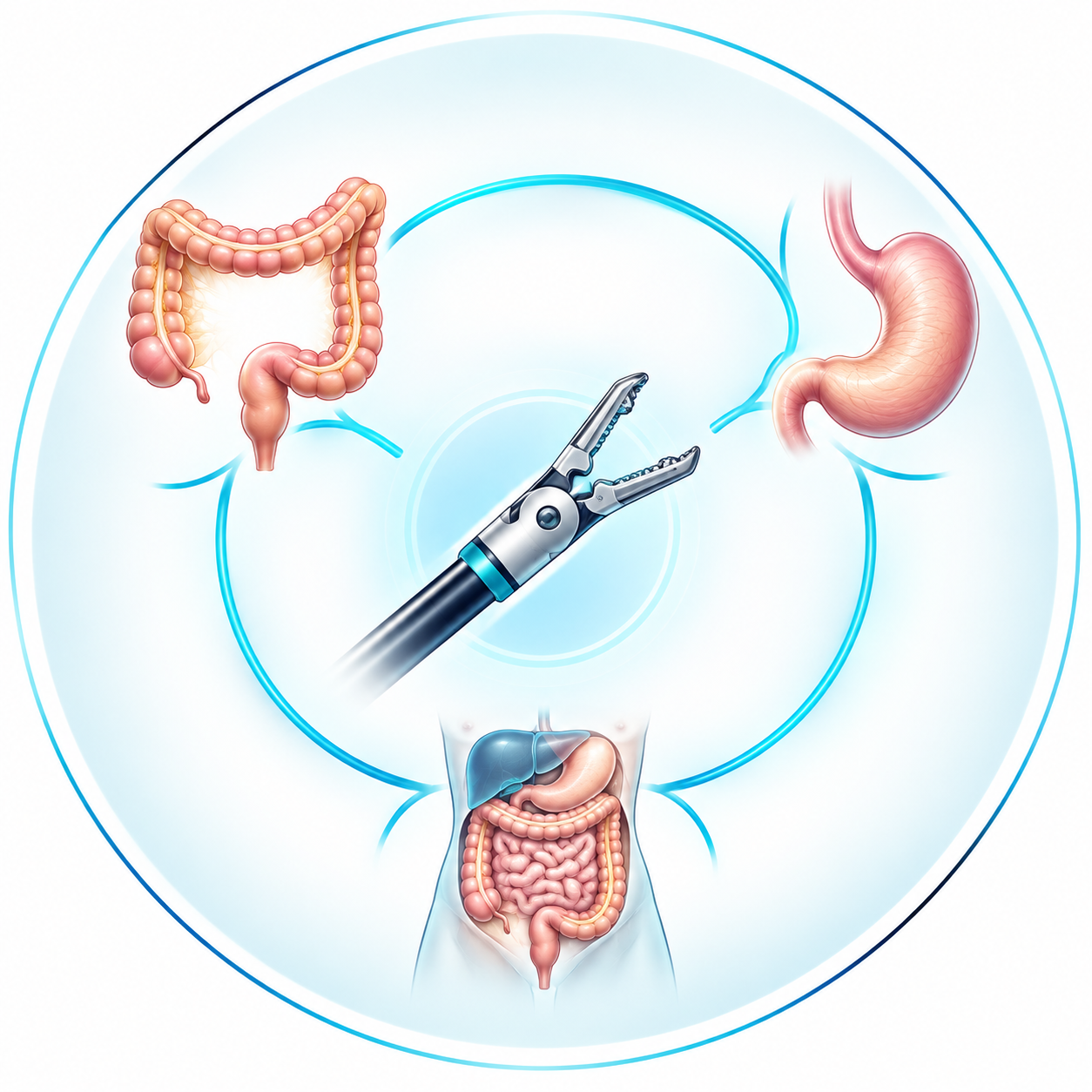
Depending on the indication and the patient’s situation, robotic assistance can be integrated into different procedures.
In my practice, its development notably concerns certain fields of:
colorectal surgery
for certain procedures on the colon and rectum;
bariatric and metabolic surgery
for certain procedures performed as part of the surgical treatment of obesity;
digestive surgery
when the characteristics of the procedure make this approach relevant.
The technical possibility of performing a procedure with the robot does not mean it is necessary to use it in every patient.
Robotics can be used for certain colorectal procedures. → Colon Cancer
A Swiss first at GHOL
First Roux-en-Y gastric bypass assisted by Hugo™ in Switzerland
On September 26, 2025, I performed the first Roux-en-Y gastric bypass assisted by the Hugo™ RAS platform in Switzerland, at GHOL – Nyon Hospital.
This procedure was an important milestone in the development of robot-assisted bariatric surgery within our institution.
But a technical first is not an end in itself.
The goal is to integrate this technology into a structured surgical practice combining:
- selection of indications
- surgical experience
- training
- teamwork
- and ongoing evaluation of practices
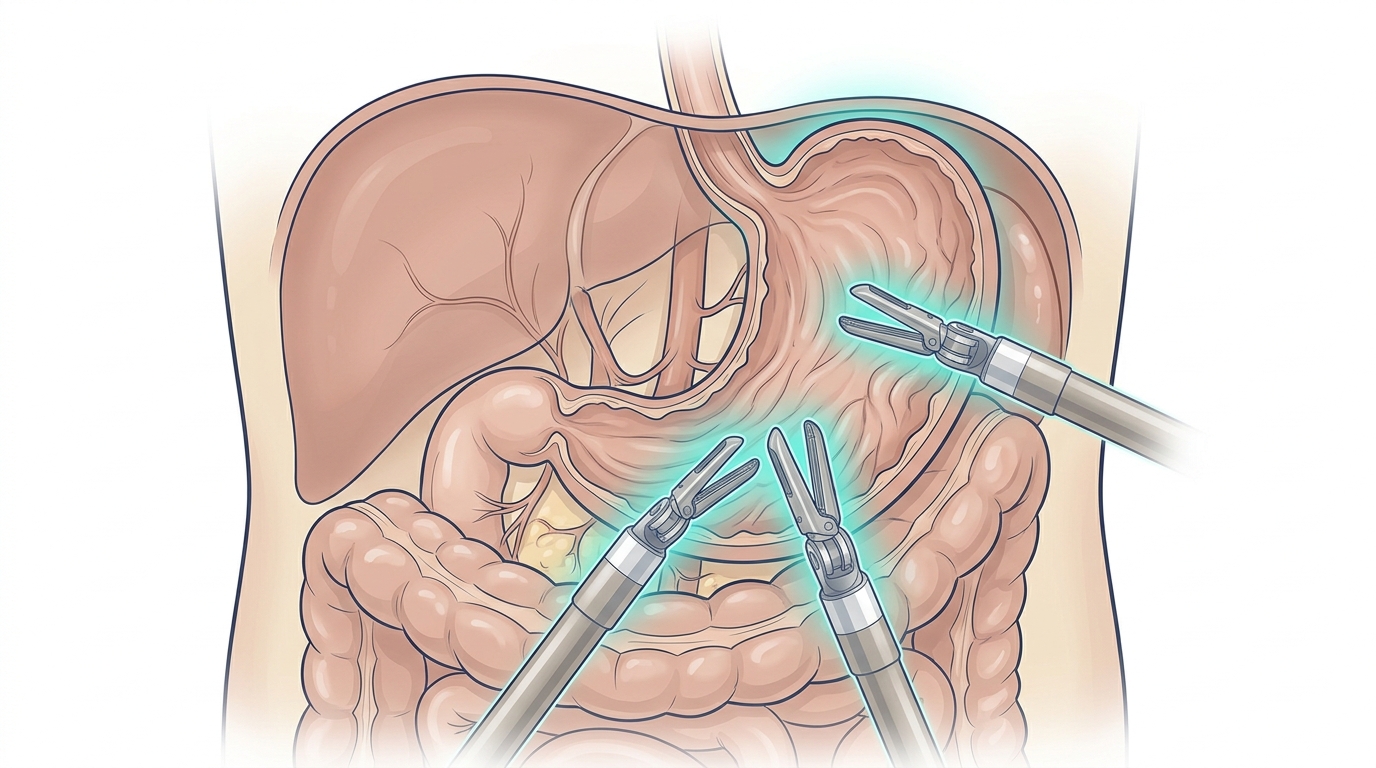
A team surgery
The surgeon is never alone with the robot
During a robot-assisted procedure, the lead surgeon works from the console.
But a team remains present around the patient.
Depending on the procedure and the organization of the operating room, several professionals take part in patient care:
- surgical assistant
- scrub staff
- anesthesia team
- operating room staff
Coordination between the console and the team at the patient’s side is an integral part of robotic surgery.
The robot is not a surgical team.
It is one of its tools.
What benefits for the patient?
Robotics remains a minimally invasive route
Robotic assistance allows certain procedures to be performed according to the principles of minimally invasive surgery.
Depending on the operation and the patient’s situation, this can notably be part of a care pathway based on:
- limited abdominal access routes
- progressive postoperative mobilization
- structured recovery
- and modern perioperative care protocols
However, the technology used to operate must be distinguished from the final clinical outcome.
“Robotic” does not automatically mean “better outcome”.
The outcome depends notably on:
- the disease
- the procedure
- the patient
- the gesture performed
- the team’s experience
- and the postoperative course

Safety: technology is not enough
Training, experience and organization
The sophistication of a device never replaces the fundamentals of surgery.
A robotic practice notably requires:
- precise knowledge of anatomy
- mastery of the procedure
- knowledge of the platform
- anticipation of difficulties
- the ability to change strategy if necessary
- and a trained team
Training therefore concerns not only the surgeon seated at the console, but the entire surgical organization.
Proctor Hugo™ RAS
Passing on the use of the platform
I am a proctor for the Hugo™ RAS platform.
This activity consists of supporting surgeons in their learning and skill development on the platform.
Robotic training does not concern only the movements performed at the console.
It also involves understanding:
- system preparation
- cart positioning
- arm configuration
- surgical setup
- instrument use
- communication with the team
- and the overall organization of a robot-assisted procedure
This teaching and knowledge-transfer activity is described in more detail on the Surgical Teaching & Research page.
This commitment also reflects the continuity of his academic career, notably within the National Academy of Surgery.
Passing on this expertise is an integral part of my activity in robotic surgery.
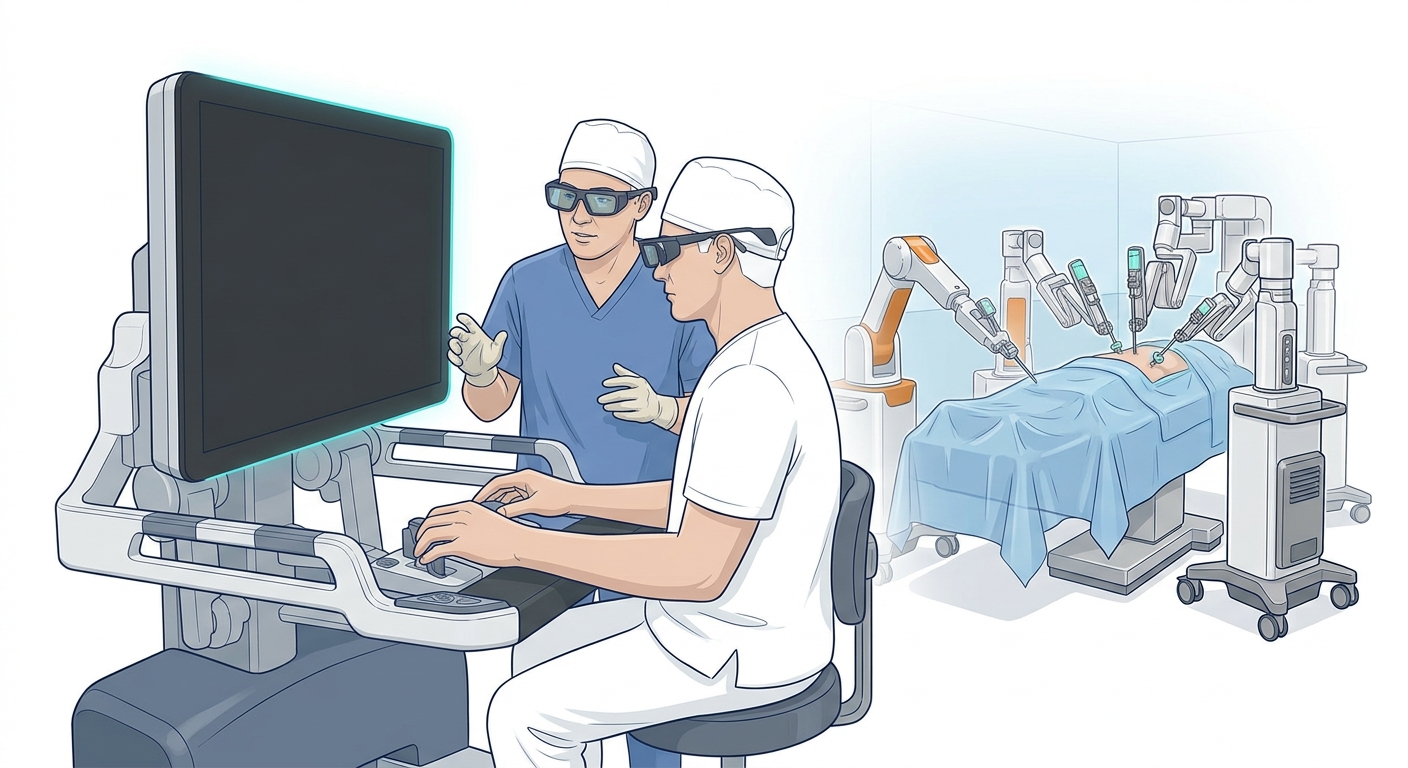
GHOL as a training environment
Surgeons and teams also come to Nyon to train
The development of robotic surgery at GHOL also has an educational dimension.
The surgery department regularly welcomes surgeons and teams for training on the Hugo™ platform.
Learning can thus take place in the real environment of a surgical team and is not limited to the surgeon seated at the console.
Patient positioning, cart arrangement, instrument management, surgical assistance and team coordination are all part of a comprehensive understanding of the platform.
This activity allows GHOL to take part in the transfer of robot-assisted surgery skills.
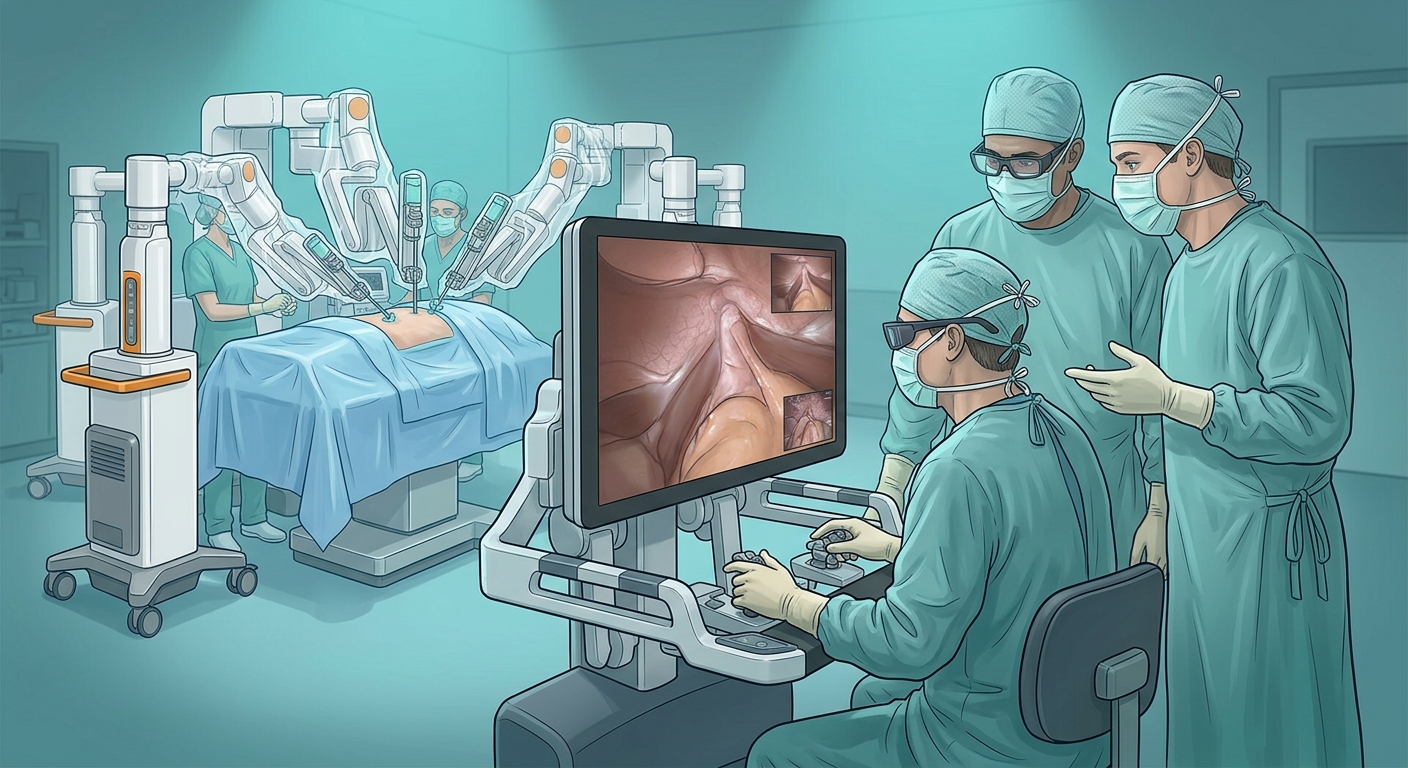
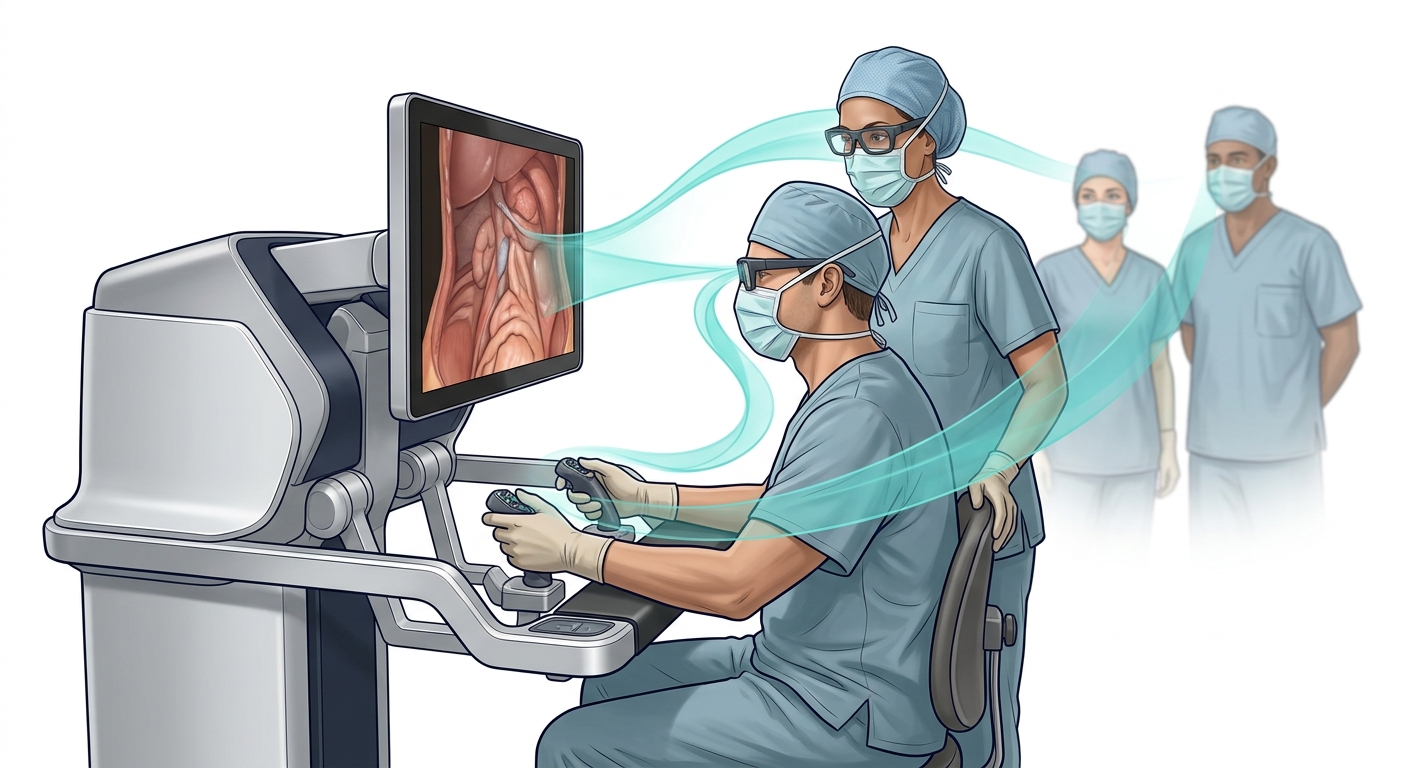
Why is the open console valuable for teaching?
Observing the same visual environment
The console’s open architecture allows the surgeon to maintain communication with the people present in the room.
In a training context, the surgeon in training and the proctor can also share the three-dimensional visualization of the surgical field.
The instructor can thus observe at the same time:
- what the surgeon sees
- how the procedure unfolds
- and how the controls are used
This configuration promotes teaching directly integrated into the operating environment.
Learning robotic surgery
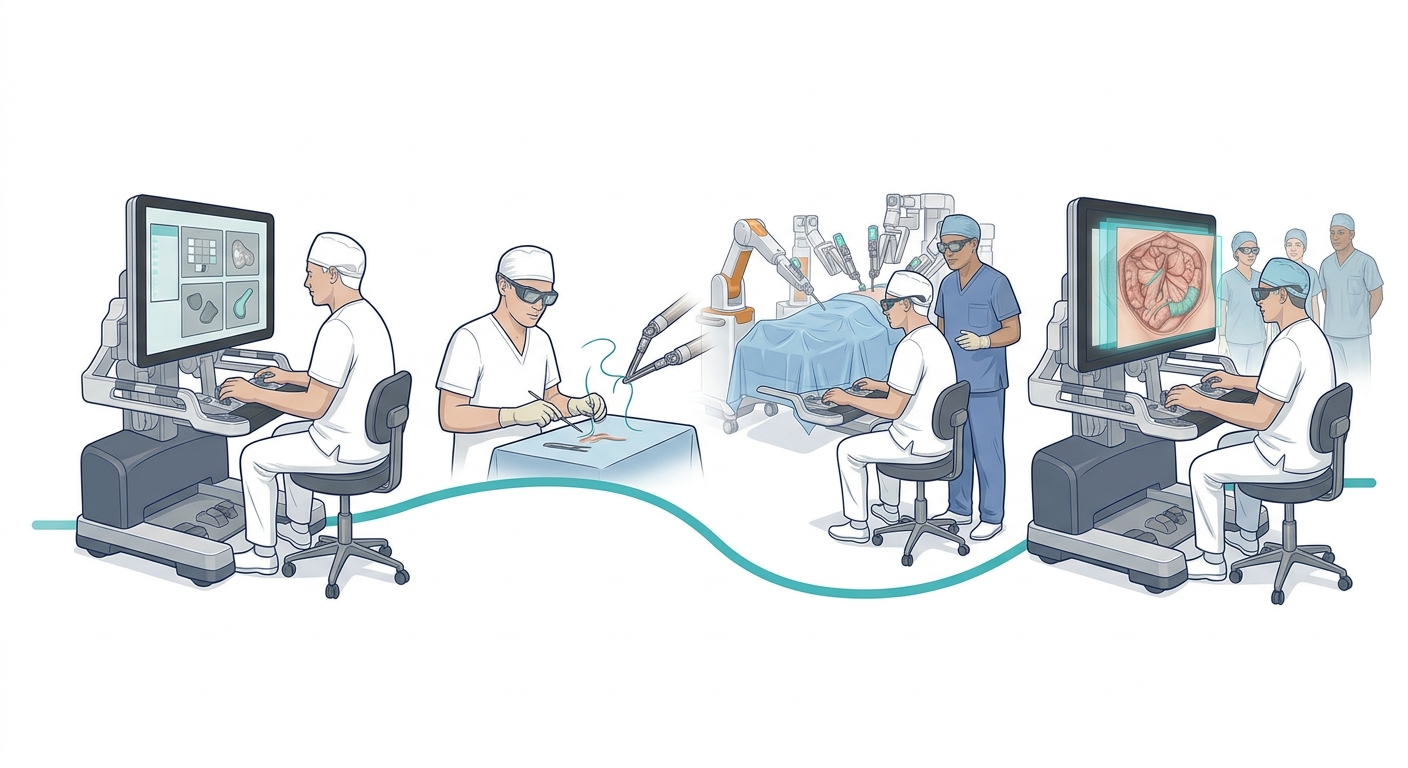
A structured progression
Mastering a robotic platform does not rest on a single procedure.
Learning is progressive and combines different dimensions:
- understanding the system
- simulation
- training in instrument handling
- surgical setup and organization
- observation
- supervised procedures
- proctoring
- then progressive development of autonomy
This progression also concerns the surgical team.
Robotic surgery is a collective skill.
Robotic surgery of the rectum
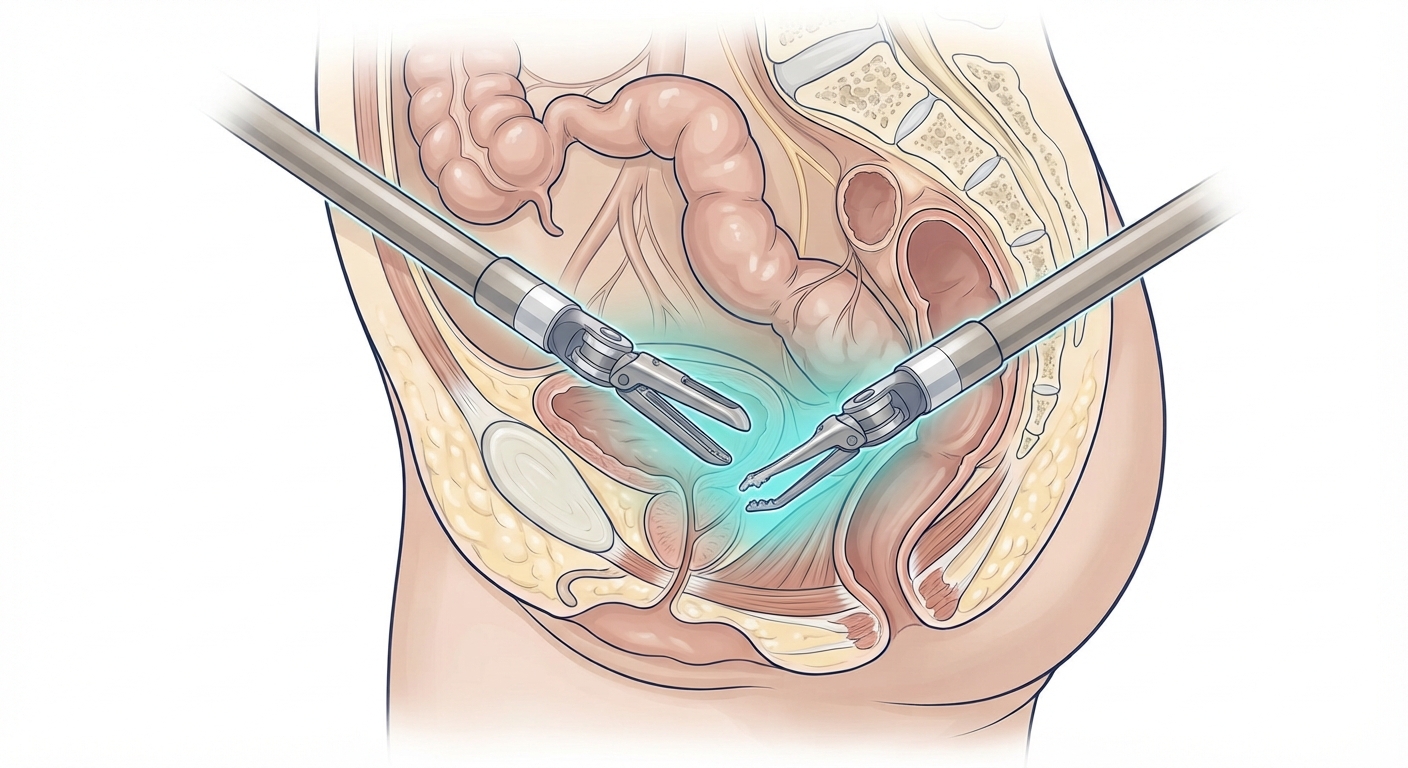
Working in deep anatomy
Certain rectal procedures require deep dissection within the pelvis.
The rectum is surrounded by important anatomical structures, notably nervous, urinary and genital.
In the lowest procedures, the proximity of the pelvic floor and the sphincter complex further adds to the anatomical complexity.
Whatever route is used, the quality of dissection remains fundamental.
Robotic assistance can provide a valuable technical environment for some of these gestures.
Certain rectal procedures can be performed by robot-assisted surgery. → Rectal Cancer
Robotic surgery and obesity
An application in bariatric surgery
Certain bariatric surgery procedures involve steps of dissection and digestive reconstruction performed by a minimally invasive route.
Robotic assistance allows the surgeon to use the platform’s three-dimensional visualization and articulated instruments during these gestures.
At GHOL, this activity is part of a multidisciplinary approach to obesity care.
Certain bariatric surgery procedures can be performed with robotic assistance. → Obesity Surgery
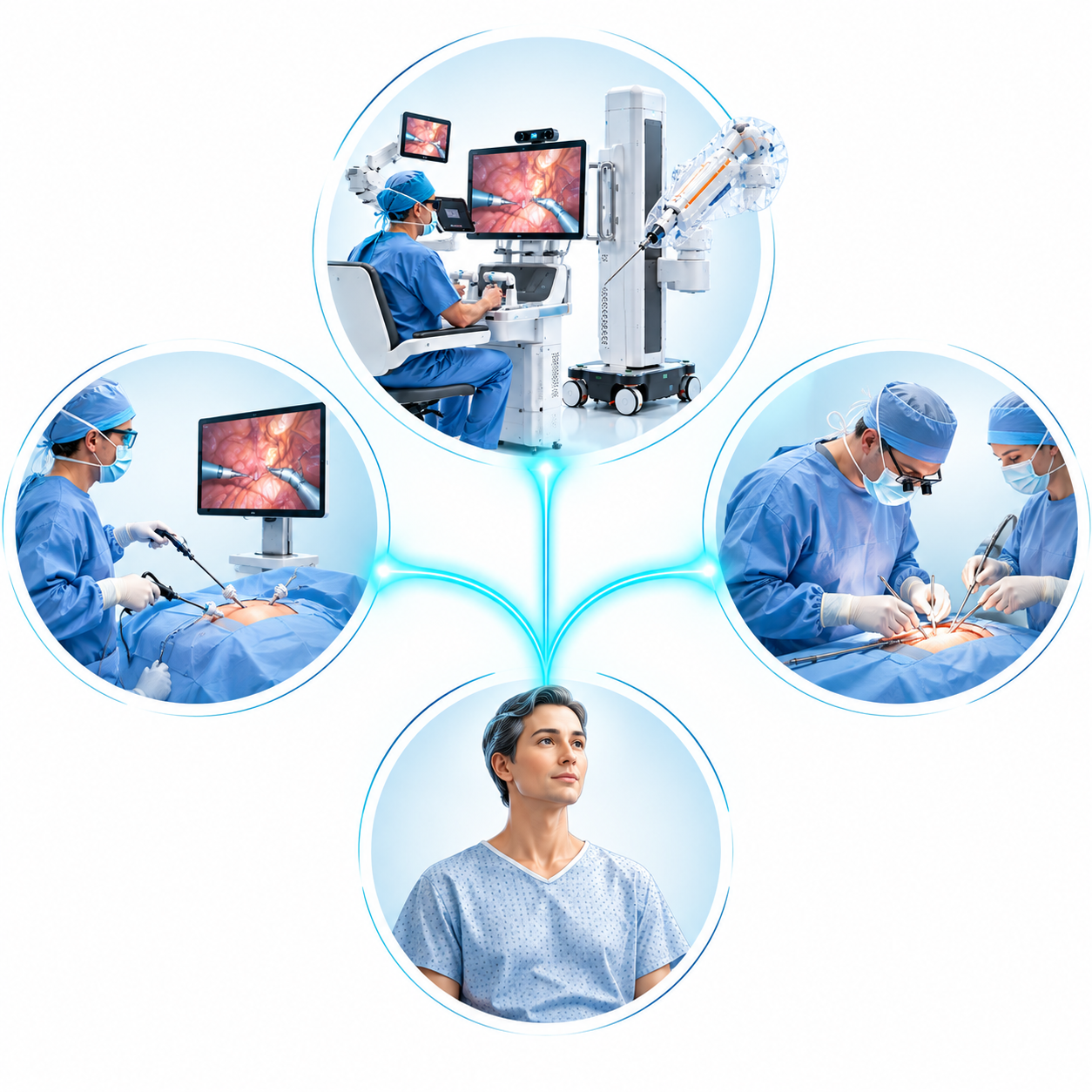
Should the robot be used for every operation?
No.
Having a robotic platform does not mean every operation must be performed with it.
Depending on the situation, a procedure can be performed:
- by conventional laparoscopy
- with robotic assistance
- or by open surgery
The choice of surgical approach must remain individualized.
It notably depends on:
- the disease
- the procedure
- the anatomy
- the patient’s history
- the clinical situation
- and the team’s experience
The surgical indication comes before the choice of technology.
How does a robot-assisted procedure unfold?
Before the procedure
The surgical indication is determined according to the disease and the patient’s situation.
The surgeon then evaluates which approach is appropriate.
Setup
The procedure is performed under general anesthesia.
The patient is positioned as required for the operation.
The minimally invasive access routes are established.
The Hugo™ carts are then positioned around the patient according to the chosen configuration.
Procedure
The surgeon takes a seat at the open console.
He controls the camera and the instruments while the team remains at the patient’s side.
End of the procedure
At the end of the operation, the instruments are removed and the patient is transferred to the appropriate postoperative care.
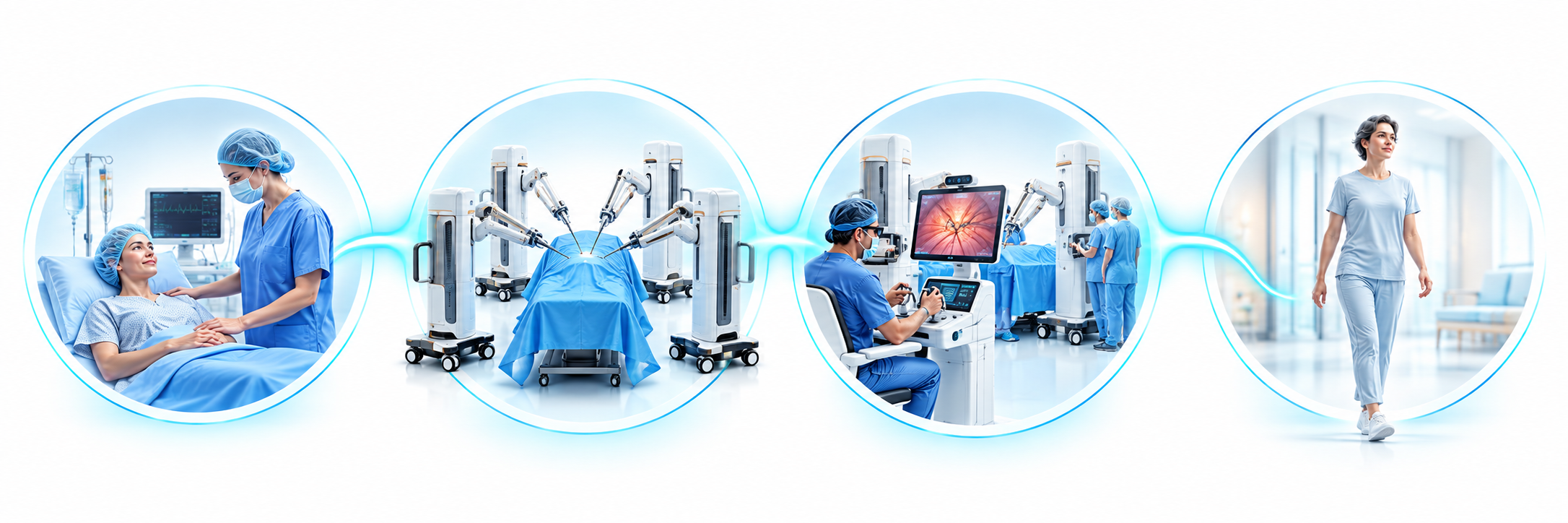
After robotic surgery
Recovery mainly depends on the procedure
There is no identical recovery for every operation performed with Hugo™.
A colonic surgery, a rectal procedure and a bariatric surgery remain different operations.
The length of hospital stay and the resumption of:
- eating
- walking
- work
- sport
- and usual activities
mainly depend on the procedure performed, the patient’s condition and their postoperative course.
Robotic therefore means neither absence of pain nor instant recovery.
Expertise, technology and transmission
A technology only has value through the way it is used
The evolution of surgery has always rested on the combination of several elements:
- anatomical knowledge
- experience
- technique
- innovation
- teamwork
- and transmission
Robotic surgery is part of this continuity.
My activity around Hugo™ today combines:
caring for patients;
developing minimally invasive surgery at GHOL;
the clinical use of the platform;
training teams;
and teaching other surgeons as a proctor.
The robot does not replace surgical expertise.
It is a new tool that allows it to be exercised and passed on.
Dr Pierre Fournier
General and Visceral Surgery
Co-Head Physician of the Surgery Department — GHOL
Proctor Hugo™ RAS

Frequently asked questions
No. The surgeon controls the instruments from the console during the procedure. The platform transmits the surgeon’s commands to the robotic instruments.
The surgeon is seated at the Hugo™ console in the operating room. The surgical team also remains at the patient’s side.
Because the instruments are positioned and moved by robotic arms commanded by the surgeon.
Among its features are notably a modular architecture based on independent arm carts and an open console with HD 3D visualization.
The platform allows different configurations. The number and arrangement of arms can be adapted to the procedure.
The surgeon sits in front of an external screen and uses handheld controllers. He is not enclosed in a console around the face.
They allow three-dimensional visualization of the surgical field displayed on the console’s screen.
The platform provides the surgeon with three-dimensional vision and articulated instruments enabling precise gestures. This does not mean that a robotic procedure is automatically superior to another surgical approach.
There is no universal answer. Both are minimally invasive approaches, and their relevance depends on the procedure and the patient.
No. The surgical approach must be chosen according to the procedure, the anatomy, the patient and the surgical strategy.
Certain colorectal procedures can be performed with robotic assistance when this approach is suited to the situation.
The platform can be used in certain bariatric procedures according to indications and applicable authorizations. At GHOL, the first Swiss Hugo™-assisted Roux-en-Y gastric bypass was performed in September 2025.
Robot-assisted surgery relies on a minimally invasive approach using several access routes. Their number and location depend on the procedure.
No. Postoperative pain depends on numerous factors, notably the procedure performed and the patient.
Recovery mainly depends on the procedure, the patient’s general condition and their postoperative course. Simply using a robot does not guarantee faster recovery.
In this context, it refers to an experienced surgeon on the platform who supports other surgeons during their training and progression in its use.
Because robotic surgery involves not only the surgeon at the console, but also patient positioning, arm placement, instrumentation, surgical assistance, anesthesia and operating-room coordination.
Yes. The surgery department regularly welcomes surgeons and teams for training on the Hugo™ platform.
Yes. Its configuration notably allows the proctor and the surgeon in training to share the visualization of the surgical field and facilitates exchanges with the team.
This decision is made after evaluating the disease, the procedure required, the anatomy and the patient’s individual situation.
Advanced technology. An indication that remains individualized.
Hugo™ gives the surgeon a modular architecture, three-dimensional visualization and articulated instruments.
But the main question is never:
“Can the robot be used?”
It is:
“Which approach is best suited to this procedure and this patient?”
When robot-assisted surgery provides a relevant technical environment, Hugo™ is one of the tools available to carry out this strategy.