
NEWS · HOSPITAL LIFE
Published on September 29, 2026
Thyroid and Parathyroid Glands: From Endocrinology to Surgery
The management of thyroid and parathyroid conditions often relies on coordinated evaluation between several specialties. Endocrinology, imaging and surgery can each play a role at different stages before an individualized treatment strategy is proposed.
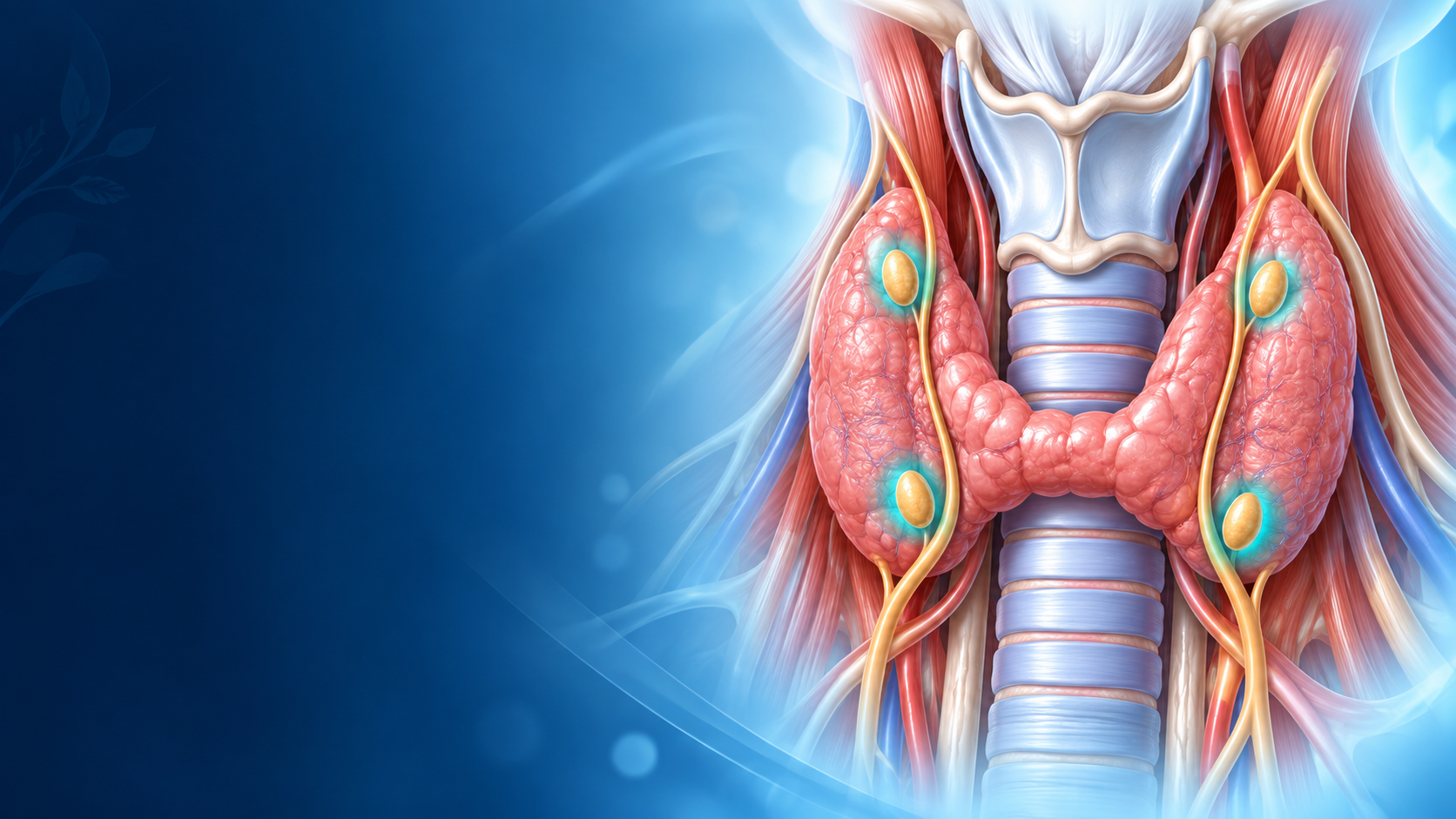
Medical illustration of the thyroid and parathyroid glands.
Care that begins with diagnosis
Thyroid and parathyroid conditions are not simply anatomical abnormalities. Depending on the situation, their evaluation may include a consultation, clinical examination, blood tests, ultrasound and, in some cases, further investigations.
Not every patient undergoes all of these tests systematically: the work-up is adapted to each situation, based on symptoms and initial findings.
Endocrinologist and surgeon: complementary roles
The endocrinologist carries out the functional and biological assessment of the gland: clarifying the diagnosis, looking for a possible hormonal disorder, and referring for further imaging when needed.
The surgeon becomes involved when an operation may be considered, based on the findings gathered during this evaluation. The surgical decision is therefore the result of joint work, not the automatic consequence of a diagnosis.
A thyroid nodule does not automatically mean surgery
Discovering a thyroid nodule does not systematically call for an intervention. The vast majority of nodules are benign and do not require treatment.
The strategy depends notably on the nodule’s characteristics, the clinical context, the results of tests performed, and any symptoms. Surgical management is only proposed in well-defined situations.
What about the parathyroid glands?
The parathyroid glands, generally located near the back surface of the thyroid, play an essential role in calcium regulation through PTH (parathyroid hormone).
The diagnosis of hyperparathyroidism is based primarily on blood tests. Imaging comes into play at a later stage, when preoperative localization of the affected gland is needed; it cannot establish this diagnosis on its own.
An individualized decision
Diagnosis, symptoms, laboratory results, imaging when relevant, expected benefits, risks and patient preferences are all factors considered before proposing a course of treatment.
This coordinated approach between endocrinology and surgery allows the decision to be adapted to each situation rather than applying a systematic response.
Sources / Learn more
Groupement Hospitalier de l’Ouest Lémanique (GHOL) — Departments of Endocrinology and Diabetology and Thyroid Surgery.
ENDOCRINE SURGERY
Discover endocrine surgery
The treatment strategy for thyroid and parathyroid conditions is always adapted to each patient’s individual situation.